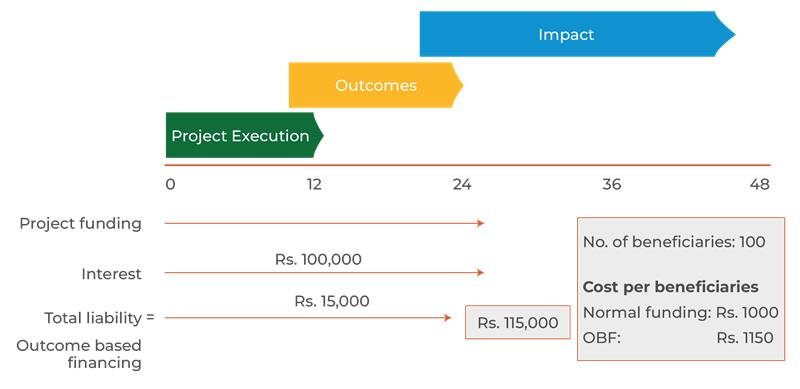
Even though Grant capital comes in post impact, it is tied up before the project kicks-off along with the Project funding. This ensures that the Risk lender gets an exit. Usually, the baseline impact is pre-defined ensuring a normal return on capital. The actual impact is certified by an independent Impact assessing agency. This determines whether a discount or premium is due to the Risk lender.
OBF is also called Impact funding when Impact bonds are used as an instrument for Project funding. Grant makers buy these Bonds when the impact is delivered.
Case study
OBF has been scarcely used in India. One of the well-known cases is Development Impact Bond (DIB) used by Educate Girls (EG) for one of its projects. Project was to ensure re-enrollment of girls (who have dropped out from schools) and they get quality education. This project ran from 2015 to 2018 in Bhilwara district of Rajasthan.
Impact was measured on two parameters – aggregate learning gains for students in grade 3-5 ( the actual impact here was 160% of the targets) and enrollment of out-of-girl students (the actual impact here was 116% of the targets).
Five key participants were involved: Educate Girls (implementation partner), UBS Optimus Foundation (risk investor), Children’s Investment Fund Foundation (outcome funder), Instiglio (deal designer), and IDinsight (outcome evaluator).
The results support the hypothesis that DIBs can enhance efficacy in delivery models.
Projects ideal for OBF
Even though every project aims to deliver impact, not every project is suitable for OBF.
Some of the pre-requisites for OBF include:
- Projects with linger time horizon will have better chance to succeed. They provide enough time for course corrections and adaptations.
- Implementation partners need to have good experience and bandwidth to measure and evaluate impact. Capacity to innovate in terms of course corrections and adapting new approaches is also essential.
- Clarity in defining the Outcome- Impact matrix is crucial
- Innovation in structuring the transaction is essential. Sweeteners such as Guarantees would attract more risk investors
Need for innovative structures in OBF
Despite huge amounts being annually pumped into the social sector, it still is starved for more funds partly because of its massive appetite but also because the infusion today is not directly linked to impact but in anticipation of impact. If more funds are linked to outcomes, implementation partners will focus more on the effective delivery rather than just execution.
Direction of thinking of the establishment is quite evident. They want more impact on the ground and soon, secondly, they want to see reduced reliance on government funding developmental projects. More OBF will address both these concerns.
In conclusion
OBF is the way to go when it comes to development finance. It may take several forms and shapes be it blended finance or impact bonds. Demystifying the concept, capacity building of partners, lowering transaction costs and simplifying execution will be key for its widespread use.