

How Has India Changed the Way It Gives?
Not just feel‑good money—how giving can change India
India is home to over 1.4 billion people, immense wealth, and equally immense needs. Despite decades of economic growth, hundreds of millions lack consistent access to quality education, healthcare, clean water, and secure livelihoods.
This article explains why philanthropy is not a luxury or a “nice‑to‑have”—it is a critical part of how India addresses its development challenges and how even a middle‑income earner can contribute to a larger nation‑building story through effective giving.
Why philanthropy matters in India: the big picture
India’s development story is complex. While the government provides the backbone of public services, public budgets must stretch across competing priorities such as infrastructure, defence, subsidies, and social schemes. We need innovative solutions to address uneven needs across regions and communities, and this is where philanthropy plays a vital role.
- Complementing public funding while enabling risk‑taking and innovation
- Philanthropy often funds pilot projects taking calculated risks on innovations & new approaches (e.g., new teaching methods, climate‑resilient farming, or digital health tools) leading to government adoption.
- Accelerating progress
- Philanthropy can mobilise resources faster than bureaucratic processes, allowing quicker responses to crises and opportunities.
- Building trust and community ownership
- Local philanthropy—whether from individuals, families, or community trusts—often strengthens local ownership of schools, health centres, and environmental projects.
For readers of Sakal Money, think of philanthropy as another layer of India’s “social infrastructure”, alongside roads, power grids, and digital networks.
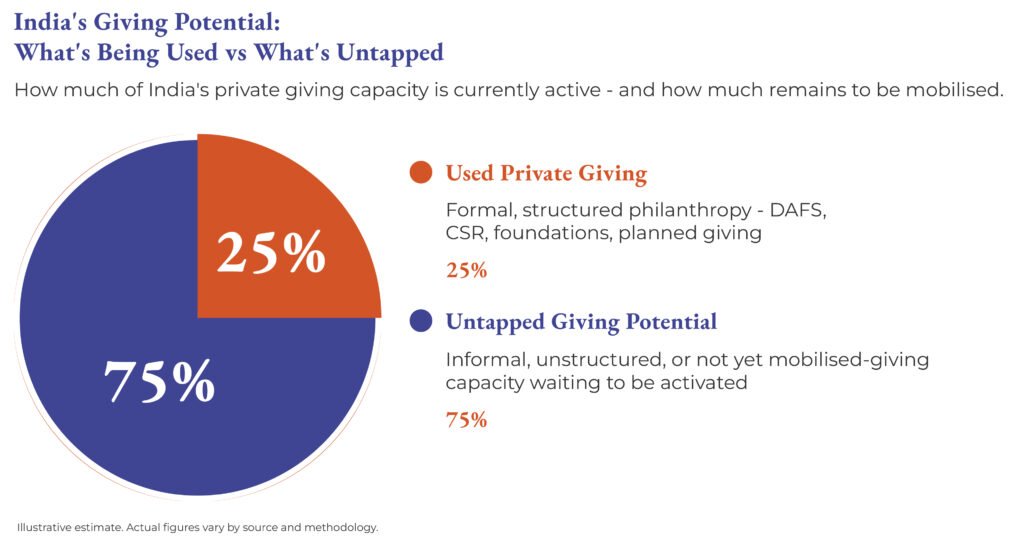
How much can India give? The untapped potential
India’s wealth has grown significantly over the last two decades, and with it, the potential for private philanthropy.
Recent studies and reports highlight two key points:
- Substantial untapped private wealth could be directed toward giving
- A 2024 BCG report on private Indian philanthropy estimates that we have the potential to mobilise tens of thousands of crores annually if more affluent Indians adopted habitual, strategic philanthropy.
- Everyday giving is huge but under‑recognised
- Studies on “everyday giving” estimate that household giving in India is already worth hundreds of thousands of crores annually, but much of it is informal, local, and not captured in formal philanthropy data.
Philanthropy as a tool for nation building
Nation building in India is not just about roads and airports; it is also about people, systems, and trust. Philanthropy can contribute to nation building in three specific ways:
- Strengthening systems, not just filling gaps
Instead of only providing one‑off relief, modern philanthropy can:
- Fund education and teacher training programmes that improve learning.
- Support health system strengthening (e.g., primary care, nutrition, mental health) not just emergency care.
- Invest in livelihood and skills training that helps people move from informal to formal work.
Over time, these efforts raise the baseline of public services, benefiting millions beyond the immediate beneficiaries.
- Supporting innovation that can be scaled by the state
Philanthropy can act as a “risk capital” for social innovation:
- Pilot a new model of low‑cost, high‑quality schooling in a few districts.
- Test a new approach to wastewater treatment or climate‑resilient agriculture.
- Support legal aid, gender justice, or disability rights initiatives that can influence policy.
If successful, these models can be:
- Adopted by state governments as part of public programmes.
- Replicated in other regions by other philanthropists or NGOs.
This is how philanthropy can move from charity to systemic nation building.
- Building a culture of citizenship and social responsibility
When more Indians give regularly, they become more than taxpayers; they become active citizens who:
- Care about public goods (schools, hospitals, environment).
- Hold institutions accountable for performance.
- Engage with communities beyond their immediate family.
This cultural shift is critical for India’s long‑term development. Philanthropy is not just about money; it is also about building a mindset of shared responsibility.
What this means for you as a reader
As a salaried professional, business owner, or investor, you may think:
- “I’m not rich enough to change India.”
- “My contribution will be too small to matter.”
Reality is different:
- You don’t need to be a billionaire to make a difference
- Small, regular donations from many people add up quickly.
- A ₹500/month donation from 10,000 people is ₹6 crore per year—enough to support a serious, well‑run programme.
- Your wealth is part of India’s giving potential
- If millions of Indians at your income level start giving intentionally, the aggregate impact would be transformative.
- The BCG report suggests that India’s private wealth could support a massive increase in structured philanthropy, if more people adopt habitual giving.
- You can give strategically, not just emotionally
- Choose a cause that aligns with your values and India’s needs (e.g., education, health, climate).
- Support NGOs or initiatives with clear impact reports and transparency.
By the end of this article, our goal is that you can see how your small contribution can create a larger impact when pooled together —and recognise that you are not just giving money but participating in nation building.
Simple “Giver Timeline” self‑check
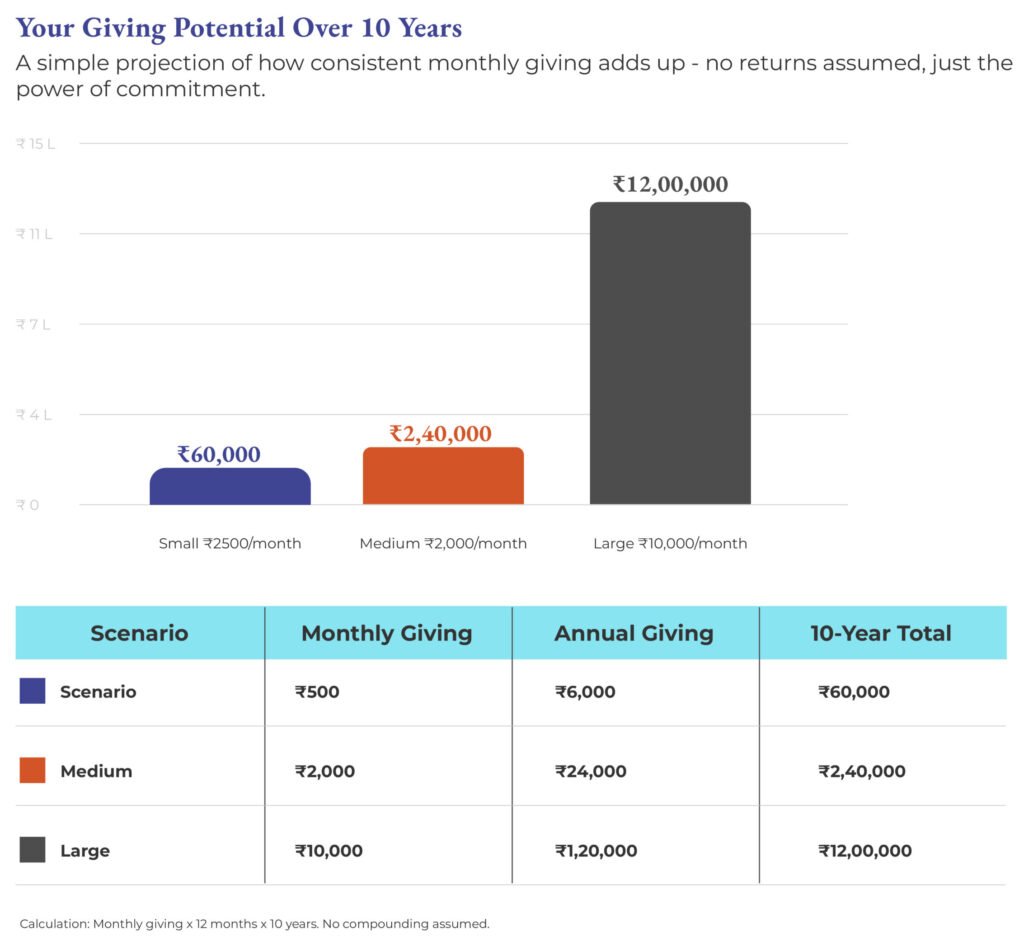
Ask yourself:
- Which scenario feels realistic for me?
- What could I do with ₹60,000–₹12 lakh over 10 years?
- Fund scholarships for dozens of students.
- Support maternal health programmes for hundreds of families.
- Contribute to livelihood training for hundreds of workers.
This simple exercise shows that even modest, consistent giving can add up to something significant.
Published in the Marathi edition of Sakal Money – October 2026