
Who pays for social change in India?
From schools and hospitals to NGOs and community organisations, India’s social sector relies on three broad sources of funding to keep its work going and growing.
- The government through public spending and welfare programs
- Corporates through mandated Corporate Social Responsibility- CSR
- Private individuals and families through philanthropy and everyday giving
Each of these sources plays a different role. Governments can bring scale. Companies can provide a structure. Individuals and families can bring flexibility and patience.
1. Government spending: The backbone of social service sector
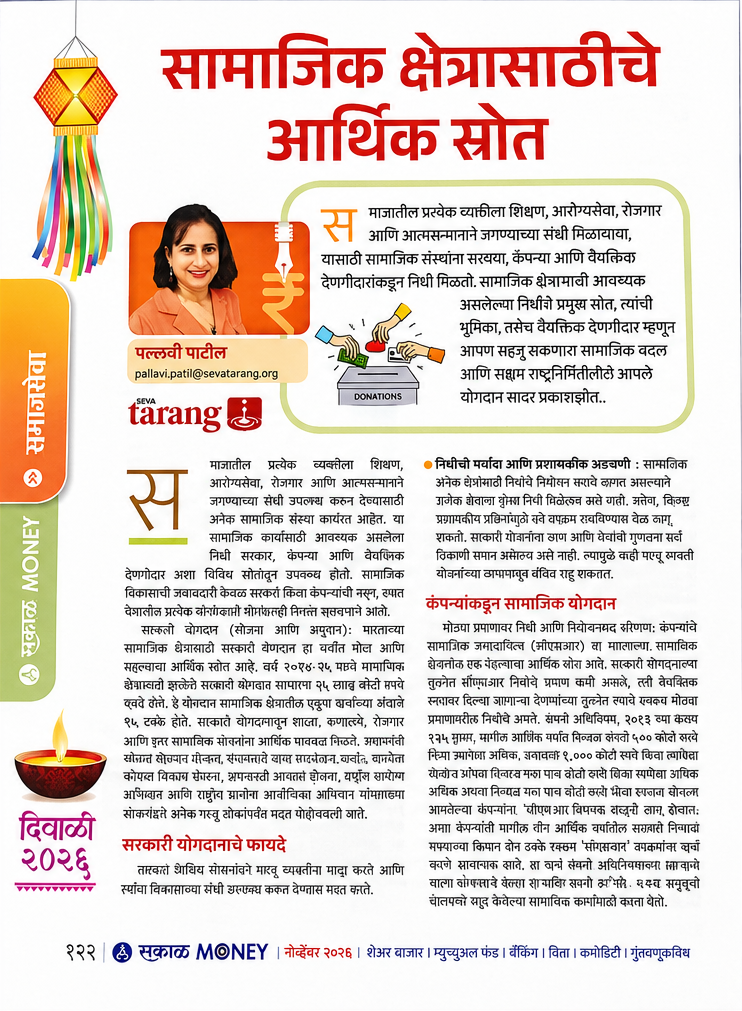
When it comes to funding India’s social sector, government provides the foundation. Government spending on the social sector was around 25 lakh crore for FY25, which is approximately 95% of the total social sector spending. Government money supports everything essential from schools and hospitals to rural employment and social protection programmes. Government programmes PMKVY, PMAY, the National Health Mission and Rural Livelihood Mission can reach millions of people at scale.
But scale also comes with constraints. Government budgets have competing priorities and changing or testing new approaches can take time.
Strengths:
- Scale and unmatched reach: The government can reach millions of people in some of the hardest-to-reach parts of the country.
- Public Duty: The Government has a fundamental responsibility to ensure everyone has access to essential services, rights, and opportunities.
Limitations:
- Many priorities, shared resources: Government budgets must balance multiple national needs, limiting the resources available for individual sectors.
- Bureaucracy and slower innovation: The scale at which government operates, testing new ideas can take time
- Last mile challenge: Even where services exist, quality and coverage may be uneven.
2. Corporate giving: Big money, structured impact
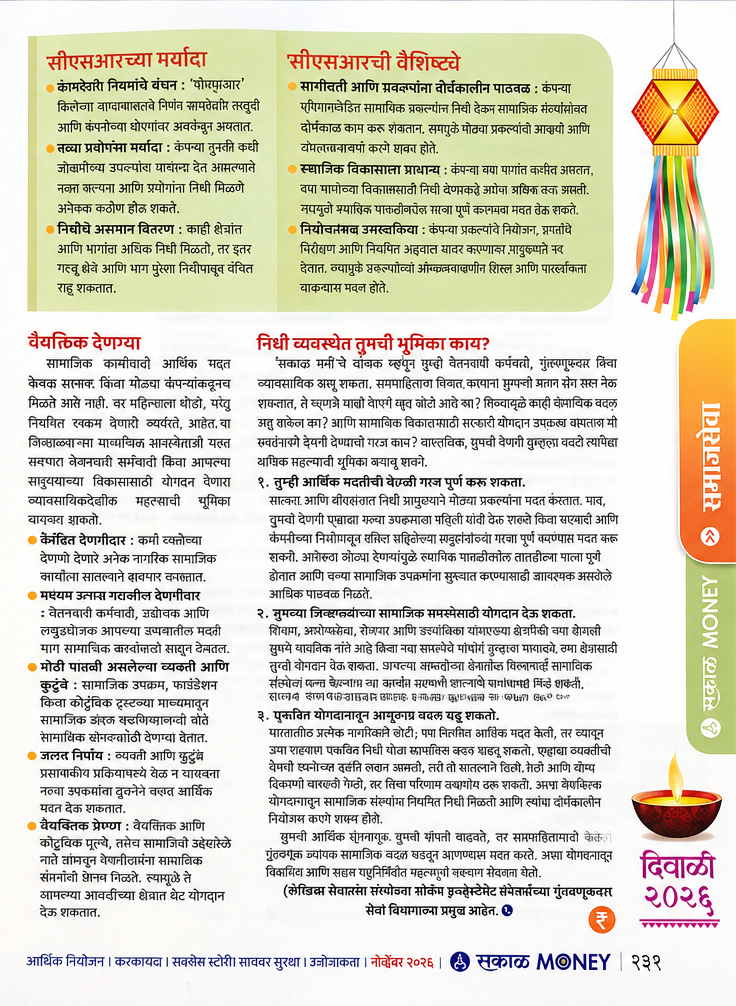
Corporate Social Responsibility (CSR) in India has become a major funding source for the India’s social sector. Under Section 135 of the Companies Act, 2013, CSR provisions apply to companies that, during the immediately preceding financial year, have a net worth of ₹500 crore or more, turnover of ₹1,000 crore or more, or net profit of ₹5 crore or more. Schedule VII of the Act specifies the eligible areas for CSR spending, including education, healthcare, environmental sustainability, rural development and other social welfare activities.
Key features of corporate giving:
- Ability to give bigger: Corporates can fund large projects that can transform communities.
- Long term partnerships: CSR funding is often structured around clear plans, measurable outcomes and formal partnerships with NGOs.
- Connection with communities: Many companies prefer to invest in projects where they operate, helping create strong relationships with communities around them.
Strengths:
- Scale and consistency: CSR channels in tens of thousands of crores annually and tend to be more predictable than private donations.
- Structure and Accountability: Corporates often demand clear project plans, monitoring, and reporting, helping bring greater discipline to how projects are implemented.
Limitations:
-
-
- Compliance led: Since CSR is driven by a legal requirement, hence funding decisions may sometimes be influenced by practical priorities and organizational requirements
- Risk aversion: Companies may avoid risky programs and gravitate towards established, lower-risk programmes.
- Geographic or thematic bias: Some sectors or regions may be over‑funded while others are under‑
-
3. Private giving: The Quiet Force Behind Change
Not all giving comes from large companies, foundations, or institutions. It could be someone donating a small amount every month, a salaried professional supporting a cause close to their heart or a business owner giving back to their community.
Private giving includes:
- Everyday givers -millions of individuals giving small amounts.
- Mid-income donors -Salaried professionals, entrepreneurs and small business owners who consciously set aside a part of their earnings to support causes they care about.
- High‑net‑worth and ultra‑high‑net‑worth individuals and families-Individuals with significant resources who drive impact through philanthropy foundations or family trusts.
Strengths of private giving:
- Flexibility: Individuals and families can fund innovative new ideas that government and corporates may avoid.
- Speed: Decisions can be made quickly, without long bureaucratic processes.
- Deep personal connection: Many donors are motivated by personal values, family traditions, or community ties.
Limitations:
- Fragmentation: When many donors support smaller initiatives independently, it can be difficult to create impact at scale.
- Much of the giving stays invisible: A large share of everyday giving is not tracked, making it hard to measure its impact.
- Trust and transparency issues: Some donors hesitate to give due to fear of misuse or lack of clarity.
Where do you fit in this picture?
As a reader of Sakal Money you maybe a salaried professional, investor, or business owner and when you think about philanthropy, two questions may naturally come to mind:
- Is my giving too small to matter?
- Doesn’t the government already cover this?
The truth is, your contribution matters more than you may think, and here’s why:
- You add a different kind of funding-Government and CSR funding typically support big programmes. Your giving can reach the smaller gaps like a promising idea that needs its first chance or a community that has not received enough attention.
- Freedom to support what matters to you- It could be education, healthcare, livelihoods, climate action or animal welfare.
- Your collective impact is large-If millions of Indians start giving even modest amounts, the aggregate can add up to something remarkably powerful and could transform the social sector
Your financial portfolio can build your wealth but your philanthropic portfolio can build the change your wealth can create.
By the end of this article, our goal is that you can see how your small contribution can create a larger impact when pooled together —and recognise that you are not just giving money but participating in nation building.
Quick “Funding Ecosystem” Checklist
To help you internalise this article, ask yourself:
- Do I understand the three main sources of social‑sector funding?
- Government, CSR, private giving.
- Which source do I feel most aligned with, and why?
- Government (rights‑based, universal)?
- Corporate (structured, large projects)?
- Private (flexible, values driven)?
- Am I willing to think of my philanthropy as part of this ecosystem, not just a side activity?
- If yes, you are ready to start thinking strategically about your giving.
In the next article, we’ll move from “who gives” to “how well does giving work” and explore the tools and ideas that help turn good intentions into real, measurable impact.
Published in the Marathi edition of Sakal Money – November 2026