How Has India Changed the Way It Gives?


How Has India Changed the Way It Gives?
From temple donations to UPI: 20 years of Indian giving
If you had asked your grandparents how they “gave money for social causes,” many would have described a simple ritual:
- Dropping coins into a temple box.
- Giving cash to a local priest, trust, or schoolmaster.
- Attending community feasts or religious events where donations were collected in person.
Back then, giving was almost entirely local, informal, and cash‑based. There were few records, little transparency, and no impact reports—just trust in the community and the institution.
Today, the picture has changed dramatically. Thanks to technology, rising incomes, and a growing awareness of social issues, India’s giving habits have evolved. This article traces that journey—what has changed in the last 20 years, what hasn’t, and what it means for you as a modern Indian giver.
How were Indians giving 20 years ago?
Around the early 2000s, philanthropy in India looked very different from how it looks today:
Predominantly local and religious
- Most giving flowed through temples, churches, dargahs, gurudwaras, and local trusts.
- Community leaders and religious figures played a central role in mobilising donations.
Informal and cash‑driven
- Bank transfers were rare; cheques were used but not common.
- Receipts, if provided, were often handwritten and not systematically tracked.
Limited awareness of NGOs and impact
- National‑level NGOs and large foundations existed, but engagement with them was mostly limited to big industrial families or urban elites.
- Most middle‑class and smaller‑town households did not see “donating to an NGO” as a routine habit.
In this era, emotion and tradition, rather than data or strategy, shaped giving.
How do Indians give today?
Over the last two decades, several big shifts have reshaped Indian giving:
1. Digital giving and UPI have arrived
- UPI‑based donations
- Today, many NGOs and fundraising platforms let you donate directly via UPI, often with a dedicated “donation ID” that you can save like a phone number.
- This has made small‑ticket giving (₹100–₹5,000) as easy as paying for a cab or groceries.
- Crowdfunding and apps
- Online platforms allow individuals and organisations to raise money for medical emergencies, education, disasters, and community projects.
- Every salaried professional now carries a “digital wallet” of giving options on their phone.
2. More structured, transparent giving
- Formalised institutions and foundations
- Family trusts and large foundations (e.g., Tata Trusts, Azim Premji Foundation, Rohini Nilekani Philanthropies) have become more visible and professional.
- Many NRIs and high‑income Indians now prefer giving through structured entities that offer impact reports and governance.
- Impact reporting and transparency
- NGOs increasingly share:
- Annual reports.
- Quarterly updates.
- Simple dashboards showing how many children were educated, patients treated, or livelihoods created.
- This helps donors move beyond “feeling good” to “seeing results.”
- NGOs increasingly share:
3. Rise of middle‑class and small‑giver participation
- The emergence of “everyday givers” and “small‑ticket donation culture” means that:
- Millions of Indians are now regular micro‑donors.
- Monthly UPI donations, salary‑based giving, and workplace‑driven funds (e.g., EMI‑style pledges) are becoming common.
Key trends in Indian giving (2004–2024)
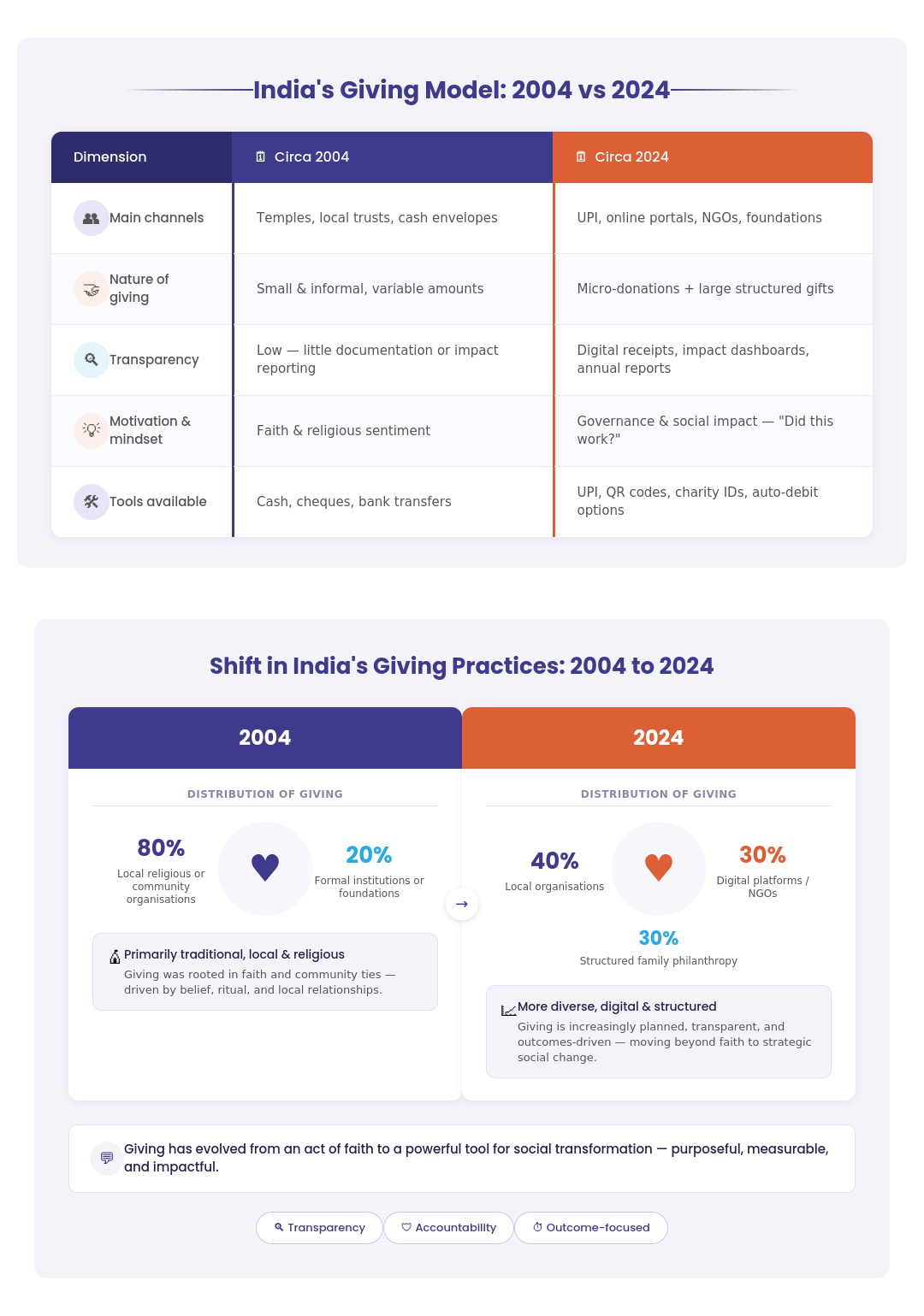
(In reality, exact percentages vary by study, but the trend is clear: digital and formal channels are rising.)
What has stayed the same—and what hasn’t?
Not everything has changed. Some deep features of Indian giving remain remarkably consistent:
What has stayed the same
- Faith and community are still central
- Many Indians still give first through temples, mosques, churches, or gurudwaras.
- Rituals, festivals, and life events (births, deaths, weddings) continue to trigger giving.
- Trust in the person or institution matters most
- Even with digital platforms, many people still choose to give where they feel personally connected—through a known priest, teacher, or local NGO.
What has changed
- From “one‑off” to “recurring” giving
- Years ago, most giving was event‑based: a festival, a crisis, a family need.
- Today, many donors opt for monthly or quarterly auto‑debits, treating giving like an EMI or SIP.
- From “just cash” to “smart money”
- Now, donors increasingly think about:
- Tax benefits (e.g., Section 80G).
- Impact (e.g., “How many students were helped?”).
- Governance (e.g., “Is this NGO well‑run?”).
- Now, donors increasingly think about:
What this means for you as a reader
As someone who reads Sakal Money, you are likely familiar with concepts like asset allocation, budgeting, and long‑term planning. The same discipline can be applied to giving:
- You are not just “giving money” you are choosing a “giving channel.”
- You are not only reacting to emotions—you can also act strategically.
Ask yourself:
- “Where do I sit on this 20‑year curve?”
- Are you closer to the 2004‑style givers (cash, local, informal)?
- Or are you already using UPI, apps, and recurring donations like 2024‑style givers?
- “If I wanted to move one step closer to the 2024 style, what one change could I make?”
- Set up a small monthly UPI donation to one cause.
- Pick one NGO whose reports you trust and start reading them.
Preview of the next article
In Article 3, we will zoom out and ask: Why does philanthropy matter in India?
We’ll look at:
- The scale of India’s social needs.
- The untapped potential of Indian wealth for giving.
- How even small, regular contributions can add up to something much larger.
And we’ll show you how your money, as a middle‑ or upper‑middle‑class Indian, can become part of a broader nation‑building story—not just charity for the day.
Simple “Giver Timeline” self‑check
Imagine a simple line titled “Your Giving Timeline: 2004 vs 2024.” Ask yourself:
- Which decade am I closest to in my giving habits?
- Mostly local, cash‑based, informal.
- Mix of local and online/digital giving.
- Mostly digital, structured, and recurring.
- Would I like to move my giving habits closer to 2024‑style? Why or why not?
- What one change can I make in the next three months?
- Example: “Start a ₹500/month UPI donation to one cause.”
By the end of this article, our goal is that you can see your own giving habits in the context of a 20‑year transition—and recognise that you are not just giving money, but participating in the evolution of how India builds a fairer, more compassionate society.
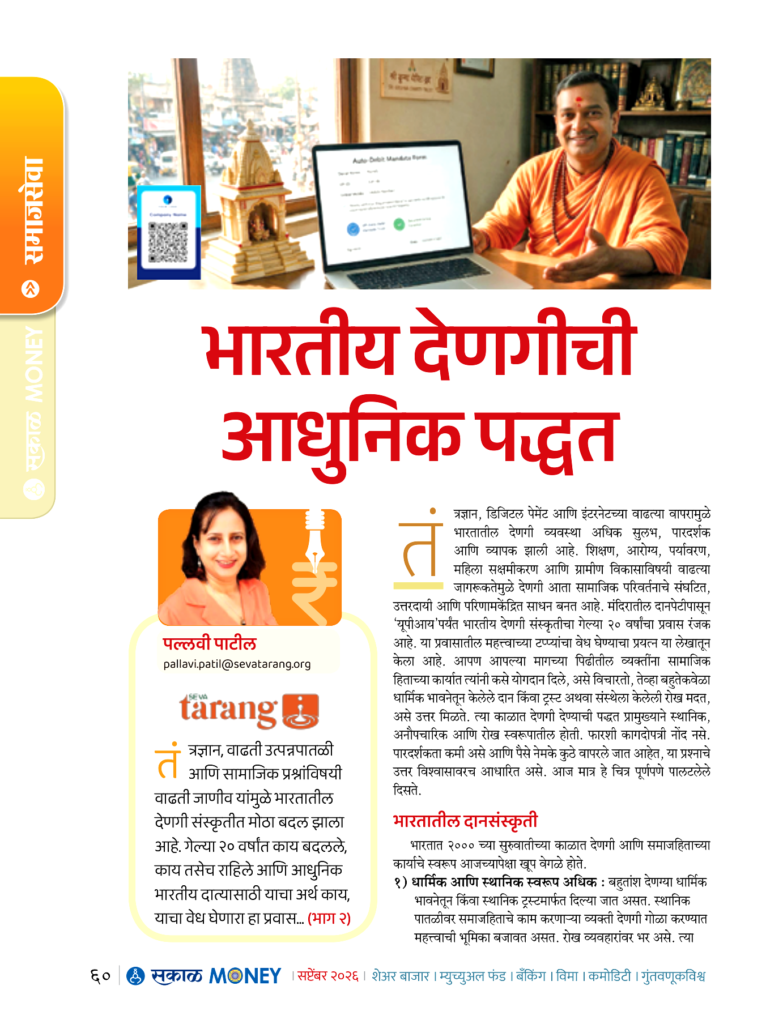
Published in the Marathi edition of Sakal Money – September 2026
Recent Blogs